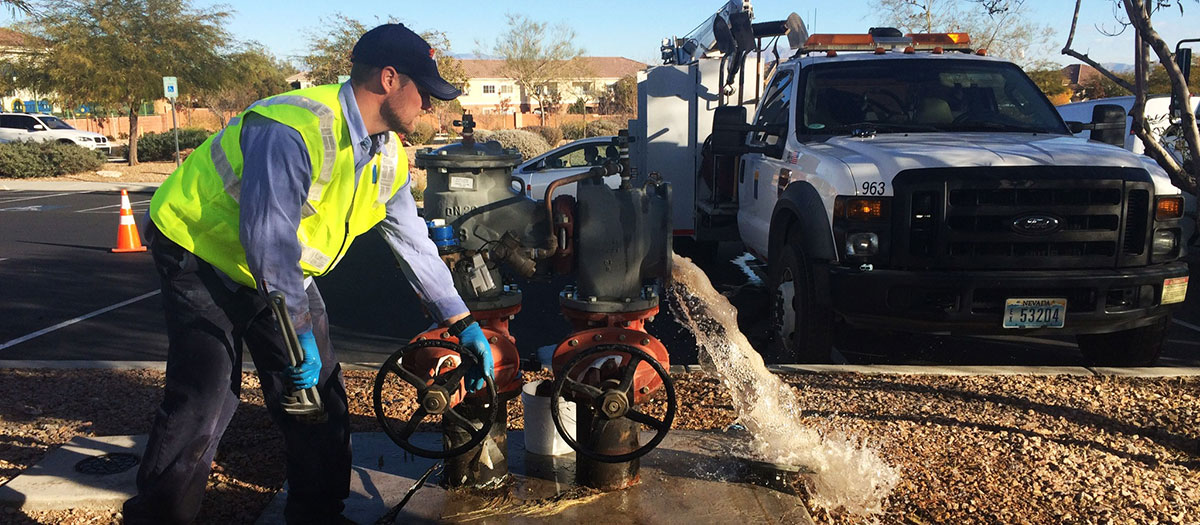
Backflow and water system flushing
The Water District works with its customers to protect the drinking water supply from pollution and contamination caused by cross-connections and backflow.
What is backflow?
Backflow occurs when water that has already entered a facility flows back into the public water system. A cross-connection is a point in a plumbing system where the drinking water supply is or could be directly connected to non-drinking water.
Backflow and cross-connections can cause unpleasant smells and potentially even illness.
The fix is a simple one: a backflow prevention device. These devices come in various types and sizes, from smaller ones suitable for home use to larger models for apartments, offices and other large buildings.
Prevention assemblies required by law
Backflow prevention assemblies are required by law for many types of buildings and plumbing systems.
Nevada state code has, since the 1990s, required builders to install the devices in new commercial properties. The Las Vegas Valley Water District retrofits buildings and water services that existed prior to the regulation's passage with backflow prevention devices.
Installing prevention devices
The Water District's comprehensive backflow prevention program requires the installation of backflow prevention assemblies on commercial buildings, multifamily properties and irrigation systems.
The Water District determines whether an assembly is required at a specific property. Backflow assemblies are installed according to Water District installation requirements, and the district will inspect installations after they are completed.
Customers who currently have backflow assemblies and those required by law to install them are assessed a monthly service fee to cover the cost of the Water District to maintain, test, and replace backflow prevention devices.
Details about service fees can be found in our Service Rules.
Have questions?
If you have any questions about backflow prevention, please call our Backflow Prevention staff at 702-258-3156 or contact us via email.
Backflow and private plumbing
Even though plumbing code provisions may be rigidly enforced on new construction, experience has shown that "on-site" modifications and alterations of private plumbing are common.
Possible hazards to the public water supply can be created due to cross-connections in private plumbing. These cross-connection hazards may be found in complex mechanical systems or caused by something as simple as a submerged garden hose.
In most cases the only practical way to ensure protection is to install a backflow prevention assembly at the point of service. That way, regardless of what happens inside the customer's property or what changes are made to private plumbing, the public water supply is protected.
Guidance for Flushing On-Site Water Systems
Anytime a building reopens after a prolonged shutdown in operation, business owners, operators and facility managers should take precautionary steps to minimize risk by flushing the building’s on-site water system before reoccupying the building. This information provides guidance and best practices for flushing plumbing systems based on recommendations from the Centers for Disease Control and Prevention (CDC) and the American Water Works Association (AWWA). Consult a professional plumber if additional assistance is required.
On-site Water Stagnation
When buildings are shut down or occupied infrequently, water will not circulate through the on-site plumbing systems, causing stagnation. As a result, disinfectants used to treat and protect the water dissipate, potentially allowing microorganisms, bacteria and pathogens to grow within plumbing systems. Prolonged water stagnation can lead to elevated levels of lead, copper, and bacteria like Legionella, which can potentially be harmful to human health.
Water Systems Flushing
Thoroughly flushing all water systems in every building where water has been sparsely used is critically important. This should be done immediately as part of a building's reopening. The objective is to flush out all stagnant water within the plumbing system to replace it with fresh, high-quality water from the municipal water distribution system.
To thoroughly flush properties, open all water outlet valves and flush hot and cold water through all points-of-use within the building. Some of the most important areas to flush include:
- faucets used for drinking water or food preparation
- drinking fountains and water bottle fillers
- showers
- kitchen and bathroom fixtures (all)
- ice machines and refrigerators with ice makers (discard ice in the storage bin, clean and disinfect the bin, and replace all filters)
- water filter or treatment systems (see additional guidance below)
- water features that generate aerosols (fountains, spas, etc.)
- parts of the water system used by children
- parts of the water system used by elderly and immunocompromised people
Building operators should also cycle dishwashers and flush all toilets and urinals multiple times.
Use care when flushing out stagnant water that no longer meets safe drinking water standards. Consult a professional plumber if needed.
Recommended Flushing Process
Flushing may need to occur in segments based on facility size and water pressure. Outlets and fixtures furthest from the municipal service connection (water meter) should be flushed long enough to allow water to flow through the plumbing system – typical flushing protocols range from 10 to 30 minutes, and multiple fixtures can be flushed simultaneously.
Other recommendations:
- Following manufacturer recommendations for disinfecting water systems or filtration systems after periods of non-use
- Open outlets slowly to avoid splashing and the creation of aerosols
- Wearing personal protection equipment including safety goggles, rubber gloves and approved N95 facemasks (where available), if needed.
Some building water systems contain numerous areas where water is stored; those systems should be drained and flushed with clean cold water. These areas include, but are not limited to:
- Cooling towers
- Humidifiers
- Hot water storage (some buildings have more than one type of heating system and hot water storage)
- Hot water recirculating loops
A single flush may not return all building water systems back to normal operation and a high level of water quality. Some buildings may require an initial flush to eliminate stagnant water and contaminants as well as subsequent flushes to circulate high-quality water from the municipal distribution system.
Water Treatment and Filtration Systems
Properties with water treatment systems like filters and water softeners will need those systems regenerated, flushed and maintained as part of re-opening activities. Bacteria can grow in stagnant water, so replacing water filters is highly recommended. Always consult and follow manufacturer guidelines for disinfecting water treatment or filtration systems.
Water Management Programs
Building owners and operators should develop a water management program for on-site water systems and water devices. Guidance is available from the CDC Water Management Program Toolkit. This toolkit is designed to help people understand which buildings and devices need a Legionella water management program to reduce the risk of the disease, what makes a good program, and how to develop it.
Safely reestablishing building operations after a prolonged shutdown can play an important role in protecting the health and safety. For more information on protecting building's water systems, visit the CDC Guidance for Reopening Buildings.